top of page
paper

THE WISDOM OF THE BEATLES

Be the first to be inspired by the most iconic band of our generation.
Untitled_edited_edited.jpg

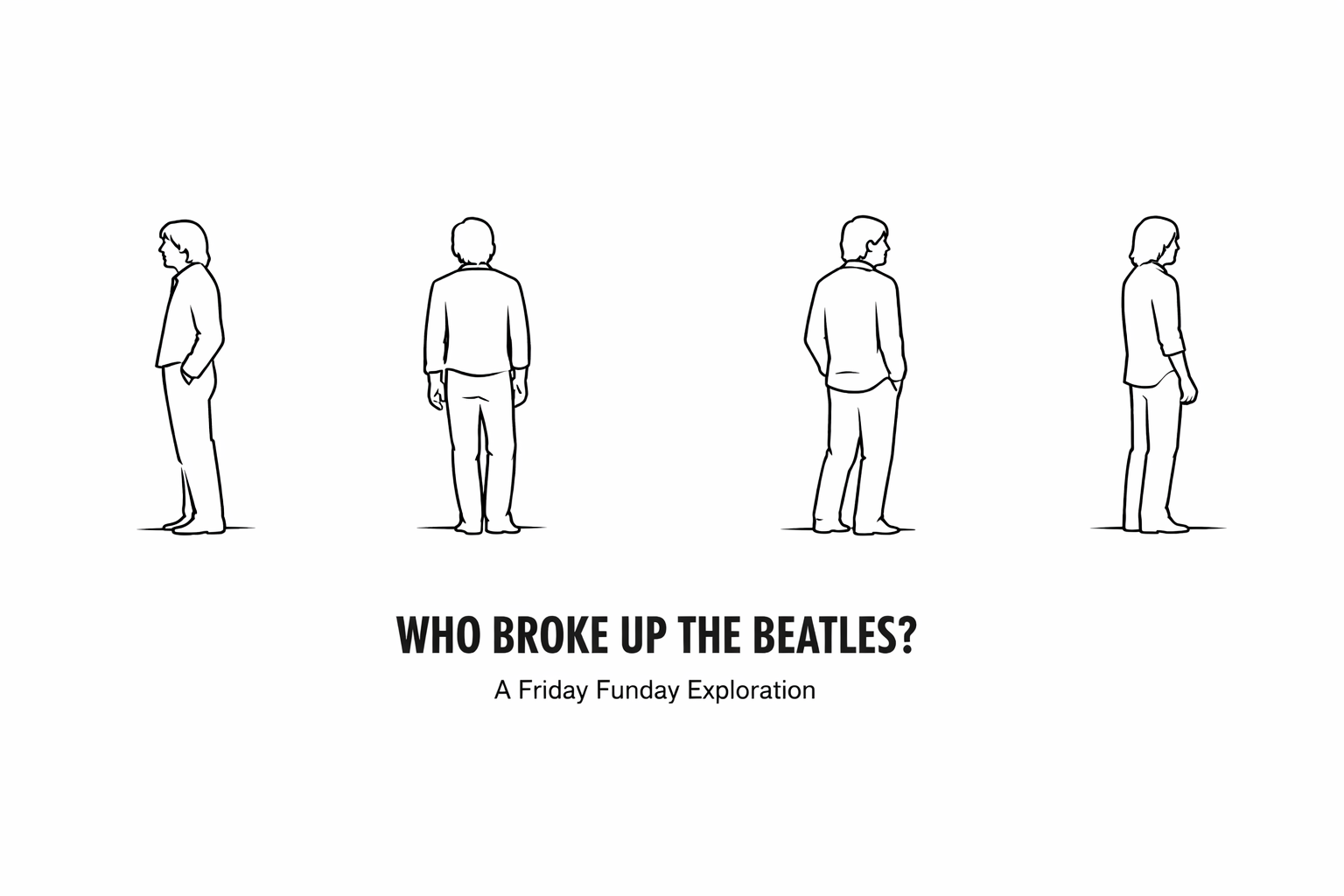
Beatles Breakup: Who Was Really Responsible?

  • Apr 9
  • 4 min read

The Beatles breakup remains one of music history's most debated topics. For decades, fans pointed fingers at Yoko Ono, painting her as the villain who destroyed the world's greatest band. But the truth is far more nuanced. The Beatles breakup wasn't caused by an outsider. It was the result of four talented individuals growing apart, each contributing to the fracture in their own way. Understanding who really broke up The Beatles offers powerful lessons about accountability, communication, and the fragile dynamics that hold any team together. This Friday Funday, we're setting the record straight.


Black and white photo of The Beatles during their final years, faces serious, representing the tension before the Beatles breakup.


The Myth That Won't Die

The narrative is familiar: Yoko Ono showed up, disrupted the creative chemistry, and destroyed The Beatles. It's a story repeated so often it's become accepted as fact. But as I explore in The Fab Four Pillars of Impact, this myth doesn't hold up under scrutiny. Yoko was certainly a source of tension when she joined John in the recording studio during the Get Back sessions in January 1969. Her constant presence broke an unwritten rule of the Beatles' creative space. But here's the critical point: this was John's choice, not hers. If it hadn't been Yoko, John would have found another way to create distance. He was already mentally checking out.


John Wanted Out

John Lennon deserves the primary responsibility for the Beatles breakup. By 1969, he was the most famous person on the planet. The pressure was crushing. He'd spent nearly a decade living in a fishbowl, his every move scrutinized and criticized. He needed an escape, and he found it in Yoko. She represented freedom from the Beatles machine. When John told the other three he wanted a "divorce" from the band in September 1969, it wasn't impulsive. It was the culmination of months of emotional withdrawal. He'd already moved on creatively, focusing on solo projects and avant-garde experiments with Yoko. The band was a cage he desperately needed to leave.


Paul's Control Problem

Paul McCartney wanted the opposite. He fought hard to keep The Beatles together, even as the others pulled away. His intentions were genuine. He loved the band and believed in their potential. But his methods backfired spectacularly. During the White Album sessions in 1968 and the Get Back sessions in early 1969, Paul's controlling tendencies intensified. He micromanaged arrangements, dismissed others' suggestions, and pushed his vision at the expense of collaboration. George later described feeling like a session musician rather than an equal partner. Paul's desperation to maintain unity ironically drove the wedge deeper. Leadership lesson: when you grip too tightly, people slip through your fingers.


George's Resentment

George Harrison's frustration had been building for years. As a songwriter, he was producing material that rivaled John and Paul's best work. "Something" and "Here Comes the Sun" from Abbey Road proved he'd arrived as a world-class composer. Yet he was still treated as the junior Beatle, limited to two songs per album while John and Paul dominated. George didn't handle this resentment constructively. Instead of addressing the inequality directly, he let it fester. His temporary walkout during the Get Back sessions in January 1969 was a symptom of deeper communication failures. When he finally exploded, the damage was already done.


Ringo's Missed Opportunity

Ringo Starr, the peacemaker of the group, found himself in a unique position during the final months. He had strong relationships with all three of the others and no ego-driven agenda about songwriting credits or creative control. He could have brokered peace. He could have facilitated the difficult conversations needed to address the underlying tensions. Instead, Ringo sided with John and George in most disputes with Paul. It was the path of least resistance, but it sealed the band's fate. Sometimes staying neutral isn't enough. Sometimes peace requires active intervention.


The Real Lesson

The Beatles breakup teaches us that team failure is rarely about one villain. It's about accumulated failures of communication, unaddressed resentments, competing needs, and the inability to adapt as individuals grow. John needed freedom. Paul needed control. George needed respect. Ringo needed harmony. None of these needs were inherently wrong, but they became incompatible. The tragedy wasn't that The Beatles ended. The tragedy was that four people who created magic together couldn't find a way to part with grace.


Listen & Learn


MINI-FAQ

Q: Who broke up The Beatles?

A: The Beatles breakup was primarily caused by John Lennon's desire to leave, followed by Paul McCartney's controlling behavior, George Harrison's unexpressed resentment, and Ringo Starr's failure to mediate. No single person bears full responsibility for the Beatles breakup.


Q: Did Yoko Ono break up The Beatles?

A: No. While Yoko Ono's presence in the studio created tension, she was a symptom, not the cause. John Lennon invited her as part of his emotional withdrawal from the band. The Beatles breakup resulted from internal dynamics, not outside interference.

Q: When did The Beatles officially break up?

A: Paul McCartney announced his departure on April 10, 1970, effectively ending The Beatles. However, John Lennon had privately told the others he wanted out in September 1969. The Beatles breakup was a process, not a single event.


Q: What was the main reason for the Beatles breakup?

A: The main reason was incompatible individual needs combined with communication failure. John needed freedom, Paul needed control, George needed creative respect, and Ringo couldn't bridge the gaps. The Beatles breakup illustrates how unaddressed team tensions eventually become irreparable.


Q: What lessons does the Beatles breakup teach about teams?

A: The Beatles breakup demonstrates that accountability matters, resentment festers when unexpressed, control tactics backfire, and neutral parties must actively facilitate dialogue. High-performing teams require honest communication and mutual respect to survive growth and change.


HOW THIS CONNECTS

The Beatles breakup story connects directly to this month's exploration of new beginnings and hope. Sometimes endings create space for necessary transformation. It also reinforces principles from the Daily Words of Wisdom, where accountability and honest communication appear repeatedly as foundation stones of lasting impact. For deeper insights into how The Beatles' dynamics shaped modern team-building principles, explore The Fab Four Pillars of Impact.

Comments


Come Together with The Fab Four Community

Join the Fab Four Community to get exclusive previews and early-bird offers.

bottom of page